
Who are cohabitants?
Cohabitants are two opposite or same-sex adults who are:
- living together in an intimate and committed relationship
- not married to each other
- not in a registered civil partnership
- not related to each other.

Cohabitants – rights and obligations
This booklet explains the rights and obligations of cohabitants contained in the Civil Partnership and Certain Rights and Obligations of Cohabitants Act 2010.
Children of cohabiting parents
Children of cohabiting parents have the same succession and maintenance rights as children born to married parents.
Mothers
An unmarried mother has automatic guardianship and custody rights in respect of her child.
Fathers
An unmarried father does not have automatic legal rights in relation to his child. This applies even where the father has his name on his child’s birth certificate. See unmarried ‘fathers’. However, a father who is cohabiting with the mother continuously for twelve months and at least three of these months are after the birth of the child, will automatically be the guardian of his child. The three months period does not have to take place directly after the birth of the child. It can be fulfilled any time before the child turns 18 provided that it is part of the twelve consecutive months during which the parents have lived together. The cohabitation period can only be calculated going forward from the commencement date of the relevant section of the Children and Family Relationships Act 2015, 18th January 2016. This means that guardianship will only be acquired automatically where the parents live together for at least twelve months after the 18th of January 2016.
See here for more about Guardianship.

Cohabiting Couple’s Redress Scheme
The Civil Partnership and Certain Rights and Obligations of Cohabitants Act 2010 came into effect on 1st January 2011. This Act introduced rights and obligations for qualified cohabitants under the Redress Scheme. The Redress Scheme is a legal safety net for ‘qualified cohabitants’ in long-term relationships who may otherwise be very vulnerable financially at the end of their relationship. The Redress Scheme only applies to cohabitants whose relationship ends on or after 1st January 2011. The court can order any and all of the following as compensation: 1) a maintenance order (different and separate from a child maintenance order) 2) property adjustment order and/ or 3) a pension adjustment order after a relationship breakdown or from the estate of a deceased cohabitant. Generally, you must apply for the Cohabiting Couple’s Redress Scheme in the Circuit Court within 2 years of the relationship ending. When attending the Circuit Court, it is advised to have legal representation. Couples who want to protect their financial interests and do not plan to marry can draw up a cohabitation agreement. It is a voluntary, signed agreement and can cover the day-to-day costs but also how assets will be separated in case of the relationship ending. It can also include a provision to say that the redress scheme does not apply, though this can be overruled by a judge in exceptional circumstances. It will be valid in court only if 1) it is signed 2) it is a contract 3) both parties have secured independent legal advice.
Who is a qualified cohabitant?
The Civil Partnership and Certain Rights and Obligations of Cohabitants Act 2010 came into effect on 1st January 2011. This Act introduced rights and obligations for qualified cohabitants under the Redress Scheme.
- for at least 5 years,
- or 2 years if you have a child with your partner, and are financially dependent on the other cohabitant. Where one of the cohabitants is still married, neither of the cohabitants will be considered a qualified cohabitant unless the married cohabitant has lived apart from his/her spouse for at least 4 of the previous 5 years.
Maintenance
For cohabitants
If a cohabiting relationship comes to an end, neither cohabitant has a responsibility to provide financially in respect of each other. However, if you are a qualified cohabitant and can show the court at the end of your relationship that you are financially dependent on your ex-partner you can apply for a Compensatory Maintenance Order, which is an order for regular maintenance or a lump sum. Payments will be dated from the date of application. The court may at the same time make an Attachment of Earnings Order which would mean that the maintenance payments are deducted from your ex-partner’s earnings. The maximum amount of maintenance you can get in the District Court is €500 per week. You can apply to the Circuit Court for a higher amount. The court order will no longer apply if the qualified cohabitant, in whose favour the maintenance is paid, goes on to marry.
For children
Both parents have a responsibility to provide financially for their child up to the child’s 18thbirthday or up to age 23 if the child is in full-time education. Where maintenance is not being paid, either parent may apply to the court for a maintenance order against the other parent in respect of a dependent child.
Where a parent or a person who has the day-to-day care of a child (i.e. in loco parentis) is in a cohabiting relationship and that relationship comes to an end, he/she can seek maintenance for the child (through the court) from his/her former cohabitant. This applies where the former cohabitant
- is not the parent, and
- is a guardian
If ordered to pay maintenance the order will remain in place up until the child’s 18th birthday.
NOTE: It is also possible for a person who is not the parent but is a guardian and has the day-to-day care of the child to seek maintenance from the parent or person who was in loco parentis.
See section on maintenance.
Private Pensions & Life Insurance
Check you or your cohabiting partner’s pension scheme to see if cohabitants are included on the policy or if not, if it is possible to change that so a cohabitant can be named as a beneficiary. Cohabiting couples are treated as strangers for Inheritance and Gift Tax purposes. The stranger threshold for Inheritance Tax is currently €20,000. Inheritances of more than €20,000 are subject to tax at 33%.
Cohabitants cannot claim income tax relief in respect of each other. 2. Cohabiting partners do not have automatic inheritance rights from each other. Cohabiting partners pay tax at 33% on gifts/inheritance over €16,250. Children of cohabiting parents have the same succession rights as children born to married parents, i.e. they can receive gifts and inheritance from a parent up to a maximum of €400,000 tax free. If you are a qualified cohabitant you can apply for provision from the net estate of the deceased within six months after the probate or administration is first granted. It is not necessary to show financial dependence if your partner dies during the relationship. An order under this section shall not affect the legal rights of a surviving spouse or civil partner. Principal Residence Relief allows an individual to receive a gift or inheritance of a residential property free from capital acquisitions tax (CAT), popularly known as inheritance tax or gift tax, if the following conditions are met:
- the premises is the beneficiary’s principal private residence for three years prior to the gift or inheritance.
- The individual has no beneficial interest in any other residential property in the State.
- The individual remains living in the property for six years after the gift or inheritance. This does not apply if you are over 55 years of age.
The Family Home Protection Act 1976 applies to married families only, not cohabiting couples. If only one of the cohabitants owns the property, even if it is being used as a family home, they can sell the property without the consent of the other partner. If a cohabiting couple is planning to purchase a property together, they should check with a solicitor if they should opt for a Joint Tenancy or a Tenancy in Common ownership option. Joint Tenancy means that both cohabitants own the property in equal shares. The partners do not have to be paying the same amount. Neither of you can sell or rent the property without the other’s consent. If one partner dies, the other partner will automatically own all the property, regardless of the deceased partner’s will. The surviving cohabitant may to pay Capital Acquisitions Tax. Tenancy in Common means that each cohabitant owns a defined share of the property. For example, one partner owns 40% and the other partner owns 60%. Each person can leave their share of the property to whoever they wish (including their partner), but they must make a will stating this.
Cohabitants (both same-sex and opposite-sex) are treated in the same way as married families for social welfare purposes. Both incomes will be taken into account when assessing income for the means test.
Cohabitants cannot claim income tax relief in respect of each other.
A cohabitant is a qualified informant for the purposes of signing the register in relation to the death of their cohabiting partner.
A cohabitant can apply for a safety order, a barring order or an interim barring order and/or a protection order.
A safety order prohibits the violent person from further acts of violence or threats of violence. It does not oblige that person to leave the family home.
To apply for a barring order/interim barring order you must have been living together for 9 of the previous 12 months. A barring order requires the violent person to leave the family home unless that person owns the family home in full or has greater rights than you to the home.
You can get a protection order immediately while you are waiting for the court to decide on your application for either a safety or a barring order. A protection order does not require the violent person to leave the home.
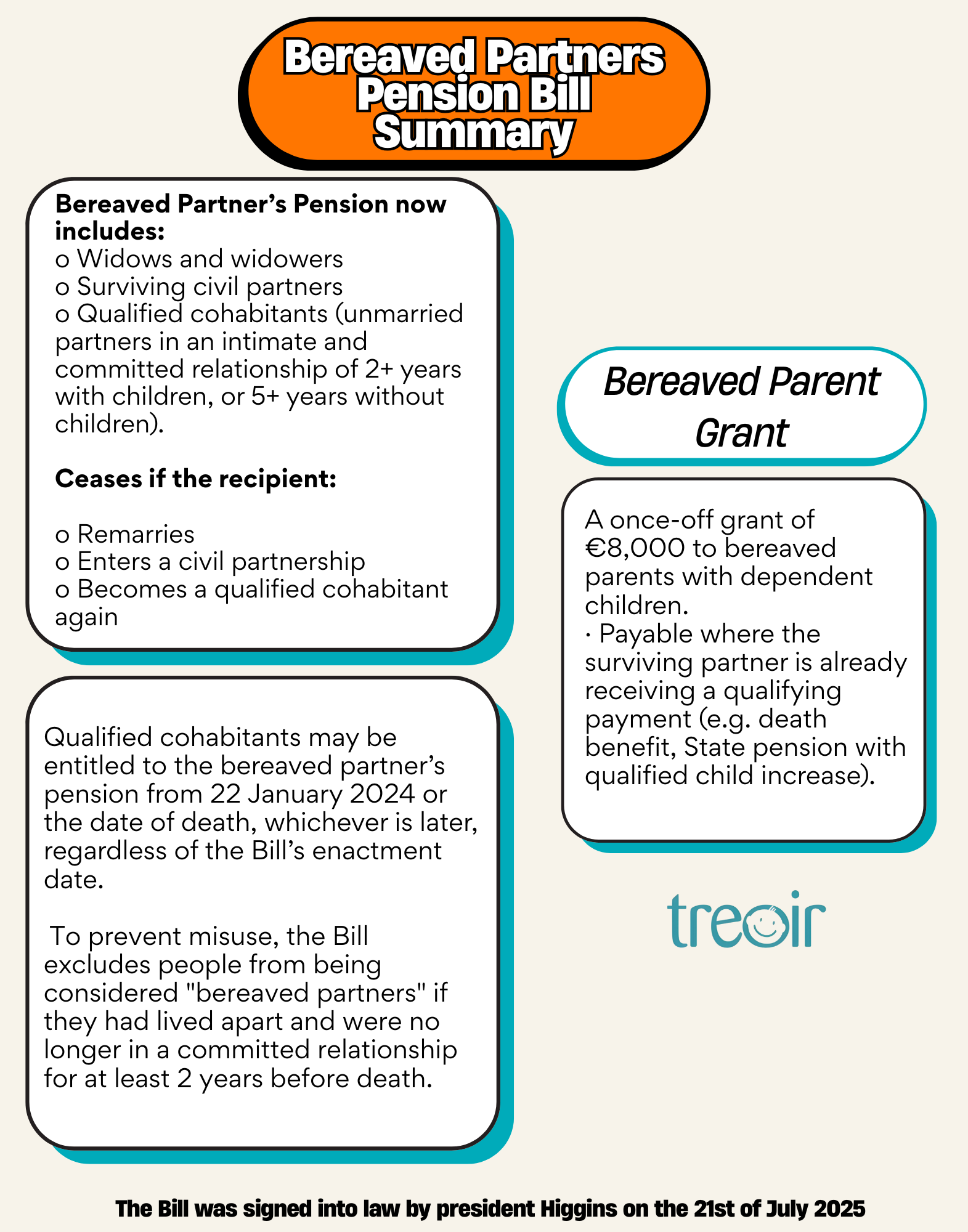
Bereaved Partner’s Pension



Useful addresses
Treoir
Federation of services for unmarried parents and their children
Tel: 01 670 0120, info@treoir.ie | www.treoir.ie
The Legal Aid Board
Locall: 0818 615 200, Tel: 066 947 1000, info@legalaidboard.ie | www.legalaidboard.ie
Free Legal Advice Centres
Tel: 01-906 1010| www.flac.ie
Cohabitants – New legal rights and obligations for opposite and same-sex couples
The Civil Partnership and Certain Rights and Obligations of Cohabitants Act 2010 introduced rights and obligations for cohabiting couples, whether opposite or same-sex. This publication gives answers to the following questions:
- Who are cohabitants?
- Who are qualified cohabitants?
- What is the Redress Scheme?
- What can I, as a qualified cohabitant, apply for under the redress scheme?
- What does the court take into account before making these orders?
- Do we both have to live in Ireland to apply for any of these orders?
- Is there a time limit within which I must apply for these orders?
- What are cohabitants’ agreements?
Information Pack 2026
Has brief information on many issues unmarried parents need to think about for example, Money following the birth, Guardianship, Access, Custody, Maintenance, Returning to Education, Pregnancy Counselling services etc. (36+ pages)
Cohabitants – rights and obligations
This booklet explains the rights and obligations of cohabitants contained in the Civil Partnership and Certain Rights and Obligations of Cohabitants Act 2010.
NOTE: Treoir 2026
While every effort has been made to ensure that the information on this webpage is accurate, no responsibility can be accepted by Treoir for any errors or omission